Showing posts with label Italy. Show all posts

Monday, December 7, 2009

Zuppa: The Next Course


Traditionally, we know what our Zuppa del Giorno show is going to be at least a year in advance, if not more. That seems funny to write, especially with how much I write about the process starting from nothing at the beginning of the rehearsal process. Yet both are true. We never start out with a show, and we always end up with a show, yet at least a year in advance we know what the show is going to be "about." The first would be about updated commedia traditions, the second about the Marx brothers, the third about silent film comedians, etc. One needs to know that much in advance so one can research, and plan, and gather materials for the horrifying moment when one finds oneself in an empty space without a single indication of where to go next, surrounded by folk who have as little clue (and at least as much anxiety) as you do.

In effect, Zuppa has officially now skipped a year. Owing to the ambitious nature of our last original work, and a focus on advancing our study abroad program, In Bocca al Lupo, we took a little break. Recently, however, David Zarko asked us to pool some ideas for the next endeavor into wholly original (or at least creatively stolen) show material. Here is what I emailed him, off the top of my head and verbatim:
  • Mummer's (or guiser's) Play: adaptable to public spaces, most characters performed in disguise or with mask - Wikipedia link. They usually have to do with good versus evil, and involve some element of resurrection. Prepare an original show utilizing style elements; perform in a different space every time. If at ETC, in ballroom, second stage, shop, lobby, abandoned rooms, etc. Scranton, all over, including weirdness like bowling alleys. In Italy, piazzas, but also tourist spots and museums.
  • Show set in a circus. I've resisted this for some time, but we really should attempt it some time. Doesn't have to be circus intensive, but can include stilt-walking and other street-theatre conducive elements.
  • The Great Zuppa Murder Mystery. Classic isolated scenario, names after Scranton locales and exit signs (Lord Dunmore Throop). Either played straight, or played a la coarse theatre -- more a play about players trying to put on a murder-mystery play, but not having their act together. OR, totally meta-: a real murder is supposed to have happened during a performance of a murder-mystery play that is being put on by coarse actors who are incapable of getting anything right.
  • A play about religion. I don't know -- religion is funny. Maybe a play about mythos and superstition, as well, or instead of. Zuppa's vampire play.
  • Another silent show, but based in something besides silent movies. This isn't really an idea. Sorry.
  • Collaborations with mixed media: visual artists, musicians, writers, dancers. The idea being that we highlight the ways in which everyone uses improvisation by performing alongside folks, united by some storytelling commonality.
  • Oh and also: A really real vaudeville show (There were some plans to incorporate a significant vaudeville presence into Prohibitive Standards, but they never crystallized. - ed.). With guest artists.
I'll probably have more ideas over time and, as is perhaps evident, I'm not especially sold on any of these in particular. Zuppa's mission statement when it comes to our original shows (in as much as we have one) is to illustrate the living traditions of the commedia dell'arte that permeate our culture, and inspire our audiences to learn more about that interconnected culture. Hence ideas that hearken to older forms, or hang on the twin cousins of homage and parody.

So what do you think, Gentle Reader? Seriously -- Which of these ideas would you like to see our merry, rotating band of "creactors" make a whole new show of? Or, better yet: What are your ideas...?

Thursday, August 6, 2009

In Defense of la Commedia dell'Arte

A disclaimer: I do not claim to be any sort of authority on the art and history of the traditional Italian commedia dell'arte.

An opinion: No one is, really. Not anymore. There simply weren't enough written records kept (indeed, this contributed to the genre's definition) and the oral tradition is -- by its nature -- subject to evolution in any and all aspects.

A philosophical theory: Commedia dell'arte theatre exists as we make it, and is defined by a method and process more than by specific style elements or traditional strictures. It is in essence a living tradition, one that influences and is influenced by the life and art that surrounds it.

Allora. I feel that there exists in my community here in the United States (and possibly all over the western hemisphere, but I write to what I know) a prejudice against the commedia dell'arte. Perhaps it's futile to address this possibility, given how small a percentage of the population has any idea what the commedia dell'arte is, even in concept, but I'm a theatre artist. Futile pursuits are what I was born to pursue. Plus, it riles me somewhat that the people who are aware of the commedia dell'arte are somehow unaware of its nature. (Just look at this riling on my forearms. And that's only the part that shows!) The Cd'A (went there - for the Twitter crowd) has gotten a bad rap.

Rep? Rap. Rap? A rep, rap, the reppie the reppie to the rep rep rap and I don't stop.

I've had two profound experiences with the genre and its practitioners in the past year, and both have fueled my desire to set the record a bit straighter, but especially the latter. First, in January we began two months' work on a commedia dell'arte and clown production called The Very Nearly Perfect Comedy of Romeo & Juliet. In this production we worked with two Italian artists, Angelo Crotti and Andrea Brugnera, and learned much about how the commedia dell'arte informed all of their work. Most recently, our study-abroad, cutural-immersion extravaganza, In Bocca al Lupo, concluded its 2009 program, in which the students received training from both these artists as well as we members of Zuppa del Giorno, and performed an original Scala scenario, semi-improvised, in Italian, in two Italian towns. This program is one that always yields surprising, dramatic results; this year, for me, it proved to be tremendously inspirational.

The problem with some people's perception of the commedia dell'arte is, in my opinion, that they perceive it to be juvenile, gross and pandering to the public. There are other factors involved that typical western audiences can have trouble digesting -- the use of masks, the lack of script -- but primarily the problem seems to lie in the commedia dell'arte being stuck with a stigma of being the lowest common denominator in theatre . . . both in terms of content and execution. And, worse yet, this perception is perpetuated by numerous well-intentioned(?) artists. I recall a performance I saw a couple of years ago in which a prop of fake linked sausages was performing with more truth than almost all of the other actors. Shakespeare suffers from similar widespread abuse -- people basing their work on their experience of the form rather than on an understanding of the function. The difference is, with commedia dell'arte theatre there's no one reminding you and insisting that it's really quite good when done well. Well, there's me, today, and there's this guy, pretty much always. And many others, but nothing like the masses of famous Shakespeare scholars and advocates.

We had a diverse group of students for In Bocca al Lupo this year, just as we did the first time we ran the program, in 2006 -- from undergrad theatre students to middle-aged non-actors, and even one professional actor who was close to my age (but even she is from Australia, where absolutely everything is strange and backward and strange). As if sadists, we threw them into intensive classes the day after their plane arrived: hours of Italian immersion class and then they were introduced to Angelo Crotti, who promptly worked our bodies so hard that the next day you couldn't help but feel that you were somehow being punished, perhaps for being so complacent a human being as to not regularly imitate the walk of an alligator for at least ten minutes every day. Heather and I attended all these classes with the students (though we had trained with Angelo extensively before, how could we turn down the opportunity to do so again?) and experienced first hand their struggles and responses. As we began to see, from the very first day, this was not a group that shrunk from challenge.

After intensive physical training and an introduction to the characters and mask work, Angelo ended his (too) few days with us by creating an on-the-spot scenario. It was a little like taking a trip inside his brain, and I know I was often struggling to keep up, so I can only imagine what my fellow actors thought of it. It was fascinating, though, because we got to superimpose Angelo's years of experience on our own relative ignorance, and try to reconcile the two. Watch as gli studenti -- Maureen Arscott, Beth Burkhauser, Marti Cate, Gemma Cavoli, Brian Jones, Becky Lighthizer, Carolyn Ruggiero, Heather Stuart and Addam Wawrzonek -- learn from a master:


Forgive our efforts at acting and mask work (for most of us, it is the first time for both or either, and everyone's just trying to do as they were asked here) but, more importantly, watch the glimpses of Angelo's work the lesson affords. The only thing lacking here is him in mask, which is an incredibly effective thing. It works when he does it because he can be believed. With all the artifice and style and for all the funny fun he's having, he can be believed. Angelo is not, perhaps, the most gentle of teachers. Yet as we reached the end of our time with him, the lessons he repeated were less to do with Arlecchino's stance or needing to put more energy into it, and more and more to do with a repeated imperative: "You must believe in what you are doing."

Angelo's other big axiom, oft repeated while we were working on R&J, is "all is for the audience." This is one that I tend to shy away from a bit, because I've been trained on some instinctive level to perceive working for the audience as pandering. What's interesting is the way in which this axiom can easily be perverted in the same way the commedia dell'arte style can, by putting emphasis on form over function. Ergo, pandering. Of course, as with most things, we have to practice the form over and over again before understanding the function. My understanding of what Angelo means, as far as I've gotten with it, is that the actor must be absolutely generous with the audience in this work. The form is to keep the mask presented forward; the function, to not only maintain the connection with the audience, but make that connection as strong and inclusive as possible.

Fast forward now, through two weeks' continued training and rehearsal, through more Italian lessons and great exercises from Andrea in character development and creation, through innumerable personal experiences (good and bad [sorry: helpful and less-helpful]), through even an initial performance of our scenario (The Two Faithful Notaries) in which we hit all the important plot points with clarity, yet somehow failed to create actual theatre. Fast forward to our second and final performance, in Orvieto. For whatever reason, we had an audience of five adults, one toddler. We held the curtain for about thirty minutes in hopes of more (not unexpected, that: Italy, after all), which is a tough time for actors in general, but especially difficult prior to an intensely physical, comic performance. At last we parted the curtains for our tiny audience.

You know that question about trees in forests and the existential quandary of an unwitnessed fall?

It was a brilliant show. Brilliant. I venture to say everyone of us learned from it and surprised ourselves. It felt to me more like the work that we set out to do with Zuppa del Giorno than even many of our own shows have. There's video of it, but I don't have it and I suspect it's pretty terrible (yes, even worse than my handheld digital camera work) and besides, video always leaves out the best thing about live performance: the direct, real-time communication with an audience. So you'll just have to believe me about how everyone, across the board, ultimately found the show together, and brought characters to life instead of simply getting them "right," and improvised golden bits of true comedy, and lived all the wants and needs and instinctive responses out loud, and on a grand, beautifully physical scale. You have to believe me because it's true, and because that belief is what I've been carrying around with me since I returned to the US of A, and it will make you smile like I do just to think of it.

At its best, the commedia dell'arte offers all the most enjoyable parts of theatre, dance, stand-up, circus (and a little you-name-it, always) in a format that is utterly inviting and inclusive. There's two sides to every coin, of course, and as one of the first recorded commercially motivated theatre genres it can be terrible. We can make it formal beyond repair, or pandering to laughter and coinage, or simply a mess. That's very easy to do. When we make it great, however, there's nothing like it. There are many contributing factors to such greatness. Lots and lots of technical work and training ought to go into any performer taking it on. It's a very difficult form, in my opinion, and as with circus part of the trick is in making it look easy. Most important of all of that, however, is belief. Believing in what you're doing and feeling, the audience's belief in you and your belief in them, and believing in the commedia dell'arte itself.

My point? Just to draw a little attention to what I consider to still be a rather neglected and abused form. Maybe also to say: Make gooder art, everyone. The things we create aren't always magic, but on those occasions when they are . . . hoo-boy . . .

Sunday, August 2, 2009

IBaL: Selected Photos


Adesso.


Dunque.

In Bocca al Lupo is a non-stop program. On their three-week course, the students have only two free days. They also have two days of gita scholastici which add the time up to two full weekends, in which we go see shows and visit towns and regions they otherwise might not, but that's as much as to say that it's a required activity. They need context for their huge undertaking, and we all need that kind of time outside the rehearsal or class rooms to really develop a personal bond. After all, a sense of ensemble is critically essential to the final project.


We had a week to plan and prepare and, quite frankly, relax before they arrived. They hit the ground running, however. The very next day, after their flight got in, they began language classes at Lingua Si and master classes in commedia dell'arte with Angelo Crotti in a converted convent. I can attest to the fact that the language classes are mentally taxing, and as far as Angelo's classes go, well . . . any Crotti class you can limp away from is a good one. They did brilliantly. There were some breakdowns, but no dramas, and by the end of the week, everyone had forgotten their aching gams, bid Angelo a bitter-sweet adieu, and managed to speak enough Italian to make sense of their little world in Orvieto.


So we moved them to Aquapendente and took away their language classes.


In Aquapendente our artistic home is Teatro Boni, a beautiful little classical theatre complete with velvet seats and crystal chandelier. Boni is where the students began their master classes with Andrea Brugnera, who emphasizes a more internal approach to character creation and story-telling. It's at this time that we also introduced them to the scenario they would be learning and performing—in Italian—and began that work. The trade-off for not having Angelo's physical demands during this time is that we begin regular “conditioning,” as I've come to call it. At the end of every day, after master classes and rehearsal, for a half an hour, I get to lead the students through strength and endurance exercises. I'd be lying if I said I didn't relish this. Some part of me misses working with a circus troupe, still.


This period is a complex one in many ways. One of the objectives is to encourage the students to learn improvisation as not just a useful skill in dealing with problems, but a preferable one. So, even as we're asking them to memorize a story and do things “right,” we're also trying to encourage thinking (or perhaps more appropriately, feeling) spontaneously and in a spirit of discovery. This ripples through everything we do, including trying to locate parking on a group trip. It's frightening. Everyone reacts differently. Most people struggle to get a grip on something concrete, to get it “right.” They ask for a written copy of the scenario, which we never provide, as it's important to learn the story through one's body and connections with others. They aim for consistency in on-stage exchanges, and we do what we can to shake them out of these. They come to rely on certain routines (such as the conditioning) and we viciously disrupt them.


It's also a complex time because we are becoming an ensemble. Relationships that are akin to a family are nascent, and manifest in both helpful and unhelpful ways (when your priority is improvisation and doing, terms like "good" and "bad" prove decidedly unhelpful). Not only are the students living and working together, and in the process attempting to avoid falling into reality television cliches, but we as teachers are becoming their directors and - in my and Heather's cases - fellow actors. We all have to depend on one another and, even as we're getting past the polite or glamorous demeanor of first encounters, the idea of treating everyone you work with as an inspired poet and artist turns from a nice idea into an essential survival tool.


In the third and final week, I invariably wonder to myself, Can it really have been only two weeks? Yet the performances loom and there seems still to be a million things to decide and discover. People despair and laugh uncontrollably and have personal revelations, and none of it helps us feel any more prepared for our first audience. The students have their second brush-up Italian lesson while we teachers hasten to pay rent on theatres and generally determine what use of rehearsal time will be most useful. And then whoosh, flash, bang: It's over. Over two or three days, all our fruition and reversed expectations. And we part ways. And it seems impossible that we are indeed going to go separate ways, much less that we've known each other for only a few weeks, and not most of our lives.


The students this year were absolutely amazing, and a privilege to work with. I'll have much more write specifically about their work and the particular experience in the coming days. Until then, I simply savor the glow of it all. While working on a show, it often seems impossible, even when it's with a script, and in English. The feeling after you pull it off, especially when you pull it off well . . . well. Suffice it to say the night never feels so refreshing in the piazza, and the gelato never so sweet.

Thursday, July 16, 2009

Le Provi Specifica


So. Hi. Sorry for the adamant lapses, but I am at this moment sitting in a tiny piazza in Montefiascone where we have discovered available WiFi. This is tantamount to finding gold, or an Etruscan ruin heretofore undiscovered, hence the long delays. Also, we are busy. Very, very busy, so I can't even pre-write and load an entry all that easily. I could no doubt find a few hot spots in Rome tomorrow during our little trip to see a Plautus show in the Roman ruins, but I'll be honest with you -- I care more about my shoulder hefting about Gracie here than I do about 'blogging. Mi dispiace. I'll make it up to you, I promise.

It goes well with me here. Every day is a new adventure in highs and lows, and everyone has had their little panics, but on the whole the group is amazing and the work is wonderful. We've seen no less than three theatre productions of various sorts (not including tomorrows), learned a lot of Italian, learned a classic Scala scenario, been to the hot springs and an arts festival in Spoleto, had some time at il lago di Bolsena, had master classes with two Italian actors, some great meals, and Friend Heather and I even performed our clown Romeo & Juliet for a crowd of appreciative Italians in a renovated Spanish amphitheater. It goes well with me here.

I miss you all, but I wouldn't have missed this for the world. I'll write more in detail soon. Or later. That's me being very Italian . . .

Friday, July 10, 2009

La Prova Generale

So you drive to Siena, and head at a serious clip toward the main piazza, because as far as you know you have maybe a 3% chance of getting a ticket to their "dress rehearsal" for the most famous bareback horse race in the world. You don't really know what that means, but . . . hell: "When in Rome."

You're not in Rome, though. After much run-walking over cobblestones, you're here:
After a good pause for a refreshing beverage (which helps you recover from the embarrassment over having covert-sprinted amongst all the laid-back Italians) you set about trying to figure out how to get a ticket. Your friend, who speak much better Italian than you do, works it out. E la:

So, you've got good seats. The seating is right beside the course, which runs the entire circumference of the (very large) piazza, and has been covered with tightly packed earth specifically for the event. I mean to say: You are RIGHT THERE. It's hard to believe someone's actually going to bring a semi-wild animal that close to you on purpose. It's also difficult to believe that you needed to rush so, because the piazza still looks like this:

But, you know, you go with it because your friend speaks better Italian than you, and has been to this event before, and because just maybe this will be a memory of the sort that never goes anywhere it can't be remembered again. It's good you kept these things in mind, because within ten minutes, the piazza goes from looking like the above to this:

There is much accepted pomp and circumstance prior to the main event. The city, you see, is divided into various neighborhoods that are represented by animals. The tortoise, the porpoise, the little owl, etc. These contradi are the participants in the race, and whoever wins the real race (the next day) gets bragging privileges for the rest of the year. So groups gather, songs are sung, children are corraled into choral groups and everyone has a boisterously good time. It's hard to imagine it getting more intense for the real thing, but it surely must. Juxtoposed beside that sort of contemporary hootenanny is medieval ceremony, such as a procession of the city emblem:

The real deal. See those guys in the back? Plate mail and wicked pikes. Wicked pikes, man. Further traditions include really skilled flag-twirling/dancing and processions of drummers, etc. The last little pre-show bit is the procession of what I assume represent the city's cavalry. These fellows march in, their horses high-stepping beautifully, swords raised:

Then you know what they do, after completing a lap? They point their swords forward and haul ass for a lap! In formation! It's seriously amazing. If I saw these guys bearing down on me, forget it. Even if I had a cannon or two. I'm going home and watching it on the news. Good luck, everyone else. Of course, after that, some clean up is necessary.
Dudes with brooms. If that isn't old school, I just don't know what is. After all these things rad, they get set for the race itself, including the latest technology. Ropes, for example. Very large ropes.
Which are spring-loaded. You know, to contain the semi-wild horses and their death-hungry riders. It's like some terrible idea of a horse race dreamed up by a Dungeons & Dragons (TM) -obsessed fourteen-year-old...
Yes, I am that fourteen-year-old.

Anyway, the horses arrive one by one, bearing the crests of their particular contrado. We got to sit right in the section where the horses begin, between the two ropes. It is due to this buona fortuna that I present to you contrado Lupa:

Now the really, really good stuff starts. It takes forever for the horses to get in line. I thought this was simply because, well, they're semi-wild horses. Ah, no. It turns out that it has something to do with signals the riders are getting from the officials/palio-captains of their contrado. Those people are standing -- as they have done for hundreds of years -- on a double footbridge that spans an alley between two buildings of the piazza. They are signaling their rider to be slow, or agitate his horse, or freaking kick the guy beside him. It's like baseball, with all the hand signals. It's part of the game, but the part that goes largely unacknowledged. This is, in fact, a primary reason for having a rehearsal for the event! The tortoise is the last contrado to enter the corral, and he sits it out for a long time, his rider's face as placid as the Buddha's, while the other horses and their riders kick and shout and otherwise try to hold it together.

You'll have to forgive me, because it started even faster than I could have imagined, so I don't have the beginning. I also don't have the end, because as soon as it was over people started climbing off the stands behind me to congratulate the winner and see if the guy who fell off his horse had died. (He didn't.) But, well, the final event of the thing is, simply put, this:

Thursday, July 9, 2009

Forse . . .

Allora.


It's been about a week and a half in Italia, which means we're in our third day of classes with the students. This also means that I have finished my third day of Italian classes, which means that my grammar and syntax may come across a little...funny...at certain points of this. Mi dispiace! The good news is that this trip and its classes at Lingua Si are improving my comprehension enormously. The bad news is that it sometimes makes me say things like, “The gelato likes to me.”


I'm writing you from one of the more impressive views of mountaintop Orvieto, sitting at a park bench not fifteen feet from a sheer cliff's edge facing roughly northeast (I think). Behind me a little ways are the ruins of an Etruscan amphitheater, and my stomach is full of pizza. It's roughly three o'clock, and it's been a good day in spite of some challenges. Such as barely being able to walk down stairs for the past two days, my knees occasionally buckling unexpectedly toward the cobblestones. You might think that given my situation, nothing could be better. And that's true, in many ways. We teachers, David Zarko, Heather Stuart and myself, have had a week here to prepare before the students arrived last Sunday, and we made good use of it. We had many adventures and misadventures the which I will write about at some point when there's more time and convenient internet access – including attending la Prova in Siena, the dry-run of their famous horse race, il Palio. (You may have seen shots of that in the latest Bond movie, Quantum of Solace.) For now what's more pressing is to talk a little about the work.


It's fascinating, thus far, what's different and what remains the same when comparing this trip to 2006's. The reason I'm staggering about this year hasn't so much to do with drinking wine with my lunch; rather it's because this week we have four days' worth of commedia dell'arte master classes with Angelo Crotti. As anyone who's met Angelo knows, he is a man of great strength and energy, and he has no problem asking as much from his students. Monday he took us through an hour's worth of strengthening exercises that kicked off the pain-fest, and yesterday he continued with various exercises and added some very committed, very acrobatic animal movement. All this, of course, in addition to working on the many postures and movements of the commedia dell'arte archetypes, most all of which involve raised arms and deep stances. I love it, but next time I'll be training up to it rather more. Jogging, she is not enough.


It is an amazing experience, studying Italian all day, then working intensively on traditional commedia in the evening. Angelo's techniques, talent, and not to mention his gorgeous masks, make for a very challenging, expanding experience. Perhaps even more amazing is to watch the students – all with varying degrees of experience and context – take on these incredible tasks. Some of them have never even seen commedia dell'arte before, yet they're finding moments of great expression in approaching it. Most of them have little to know experience conversing in Italian, yet every day they manage to communicate more and more with it. (For me, for the first time, the language feels useful rather than intimidating – just as a personal sidenote.) Everyone's a little (okay – a lot) frightened of the ultimate goal: To perform an original commedia dell'arte scenario in Italian, for Italians. Yet that is just how we were in 2006 as well, and it turned out to be wonderful. I'm sure none of us expected to be able to hold a conversation in Italian on the first day of classes, either, but we all did.


The major difference between our last full program and this one is the amount and variety of training and practice we'll be making use of. In fact, we're only spending this week in Orvieto. Next week we'll be back for brush-ups in Italian, but largely we'll be in Aquapendente at Teatro Boni, our artistic host. There the students will take classes with Andrea Brugnera and we'll begin the work on the actual Scala scenario we're using, The Two Faithful Notaries. That, too, is when the major events begin. So far we've only had meal-oriented ones – and those are of course great – but starting at the end of this hard-working week we start seeing sights and shows. Hopefully I'll be able to write about those individually as they occur...or anyway, soon after when they actually occur.


I've done a lot of reflecting during all this, of course. Italy is enticing, exciting and extremely challenging to me, all at once. I've had some major (insofar as my experience extends) victories on the trip already, as well as some harrowing moments and, let me face it, outright failures. Yet the failures have been more productive, somehow, than I've allowed them to be in the past. We're trying to teach, after all, that risk and mistakes are great tools to improving communication. It seems I take that lesson more and more to heart the more I challenge myself in this way. God, is it challenging! Which is both an outburst of frustration and an exclamation of thrill.


I'll write more soon, e vero. Until then, may the gelato like to you as well, my friends.

Thursday, August 28, 2008

dell'Arte


Contrary to popular (American) opinion. the "dell'arte" in "Commedia dell'Arte" does not in fact refer to art. At least, not in the sense the word has come to be used in most of the rest of the western world. The term actually describes the professional aspect of this form. It was one of the first recorded theatrical forms to transcend from rite, ritual or plain event into commerce, into a salable product. The "dell'Arte" also makes a tie between the theatre and the community by in effect introducing a guild mentality to theatre troupes. As the efforts became more regular and more commercial, actors formed troupes--or guilds, if you will--thereby joining the ranks of other professions in 16th century Italy. This is an apt parallel to my activities this week. Under the auspices of the newly-rebranded and resident-company-enriched Electric Theatre Company, I'm leading, along with Friends Heather Stuart and Dave Gochfeld, an intensive workshop in commedia dell'arte for the theatre students of Marywood University.


We did something similar last year--and have many of the same students back--as a part of ETC's "Portal Project" in collaboration with Marywood. However, last year's workshops simply emphasized the creation of original characters and improvisations for public performance; this year we're armed with our experiences with Angelo Crotti and a big pile of reference books, and the emphasis is on providing a very pragmatic, concise overview of the commedia dell'arte as a living tradition. This week will culminate in a few public, staged yet semi-improvised, performances of a Scala scenario for the visiting public of Scranton's annual Festa Italiana on Sunday and Monday (an event I must sadly miss, as obligations necessitate my leaving town Friday night). So in a week, we give them all they need in terms of history and techniques, learn and rehearse a show, and open and close the whole endeavor. And if you think that's hard for us, keep in mind that for the students it's their first week back at school after the summer break.


It's been a great week. Any incipient panic of the seeming impossibility of our task has been balanced out by the excitement of learning more and more about what we're teaching as we go along, and by the students' complete and selfless dedication to the work. They really are an incredible group to be working with. We have about 25 of them, and of those, a full 21 are electing to perform in the final product. That's a lot of roles to cast in a classic commedia dell'arte scenario (only one in our book lays claim to that many specific characters), so we're looking at possibilities for incorporating porters, musicians and police into various lazzi. In fact, at this point we've got a lot to decide about setting, logistics of the space and timing in general, things that don't even have a thing to do with the work we're doing in class . . . apart from how critical they are to informing the students' expectations as performers, of course. But what's that, really, in the grand scheme?


Yesterday afternoon, while I was trying to determine the best format for a 'blog devoted to details of catching my performances and workshops (coming soon to a link list near this entry), I got a call from the talent management agency I freelance with, Dream Weavers Management. They wanted to know if I could make an audition at 5:20 that evening in New York. My agent on this particular possibility was talking a blue streak about details, and before I could find a breath-space within which to insert the information that I was in another state on paying work, I heard that in was for a commercial filming in Canada, and looking to pay a non-union actor $10,000. Gulp. This is small potatoes compared to the residuals an actor ought to get for years from (what I assume must have been) a nationally syndicated commercial. But let's not kid ourselves--that would be the biggest paycheck yours truly ever garnered for plying his humble craft. I was, in a sense, saved by the beep. My agent had a call come in on the other line and promised to call me back. In the pause, a handful of minutes, I quickly reviewed my options. I could conceivably make it back to New York in time for the audition. My agent called me back, and before she could get going again, I informed her I was out of state and that I was afraid I couldn't make it. She said she understood, hoped for next time, and quickly hung up to get on with calling the rest of her mid-thirties white males.


I'm a professional actor. And that was the right choice.

Thursday, August 14, 2008

Under Studious Conditions


This week I expected to be writing about my experience participating in a (paying!) reading of a play adaptation by Adrienne Thompson of Aphra Behn's The Widow Ranter, but something came up that took precedence. Namely, a fellow actor whom I consider to be a friend got news of an illness in his family, and had to leave town unexpectedly. This shouldn't normally affect my life terribly directly; we're not close or constant friends. However, this same actor was appearing in a show in this year's Fringe Festival, a show based in commedia dell'arte traditions. So I was contacted to understudy the role. He left town last Friday, and the show, La Vigilia, opened yesterday.

I didn't go on. Actually, I should say I haven't gone on. My friend came back Sunday, and is going to be around for shows through Friday. Thereafter, it remains a question. He could be fine to perform in every showing throughout the Fringe's erratic scheduling, and I could get the call that I'm needed at any time between Friday and the 23rd. This is the first time I've ever understudied anything, and it's with very short notice. My only advantages have been my experience with commedia tropes, and having read the play about a year ago when the writer emailed it to me in the hopes of collaborating on it. I'm not complaining, mind: these are good advantages. Still and all, it is a new experience, and frankly pretty stressful -- like inviting an actor's nightmare upon myself. I ran through it once with the cast, without proper blocking notes, and that's about it for my practice. The rest is up to me. Perhaps it's needless to say that I'm attending every performance.

It's a unique experience in more ways than one. First there are the little ways. My (friend's) character sings a serenade betwixt acts two and three, which brings to the forefront with a slightly creepy synchronicity my recent musings on my relationship to song. There's also a strange spirit of reminiscence to all this for me, being that I'm unexpectedly reminded of my experiences participating in the Fringe last year, but in a much more detached way. Finally, on the side of smaller, there's a weird feeling of being someone the cast and crew need, but not someone they want. Not that they hold anything against me in any way! I represent the possibility of some unwelcome tidings, though, and on top of that I'm not allowed to help. I can, of course, jump in here and there to lend a hand, but there's some question as to how much I'm actually helping. Take for example the extremely quick set-up and tear-down that has to happen for the Fringe; it all has to happen in fifteen minutes to keep the space on schedule for the following shows. Therefore it would seem natural I should dig in and help, except that if I ever have to act in the show, that'll be one less hand that night and nobody wants to get used to the extra help leading up to that. So some bat me away when I lend a hand, and others wonder at why I'm just sitting there, and I can't blame either faction. It's confusing.

The larger ways in which it's unique have to do with approaching a familiar form with unfamiliar people and, well, approaches. La Vigilia is a very fine, neo-classical script, in my opinion. I like it a lot. Though clearly based in commedia dell'arte tropes, I don't perceive it to be traditional commedia dell'arte because, in my experience, the traditional sort is semi-improvised and contains rather baser character types. The characters in La Vigilia are nobler by far than the archetypes we know best from commedia dell'arte, but this serves the story well and I imagine helps to keep the sympathies of a contemporary American audience more immediate in the theatre (although the recent spate of Apatow comedies prove a lot of success with ignoble characters, at that). Perhaps because of this, the approach of the producing team seems to have been to put the emphasis on the language more than any broad physical characterization or lazzi. The zanni have their moments, of course, but even they are emblematic of this "departure." The male servant is pretty classically Arlecchino, but the zanna seems to be an interesting blend of Francescina and Colombina types, with just a dash of Isabella to smooth the flavor.

In that the script is never departed from, I find myself fascinated with the narrative complexities of the piece, though few outside of my own experience would likely describe the plot as especially complex. Had I directed the play, I would have approached it from a completely different angle, and I'm not convinced this would have been for the good of the final product. Still, I can't help but wonder how my production would have been different. Certainly it would have focused more on the physical images created, and broadened their scope. I think also I would have aimed for a certain Fellini "surreality," similar to what informed Zuppa del Giorno's first show, Noble Aspirations. (Incidentally, in my experience of Fellini and Italy thus far I find absolutely nothing surreal about what the man was portraying. That's just Italy.) This is part of why I believe it may be just as well that I didn't direct this piece. It's quite lyrical, and set in the 1950s -- though I would like to have seen those two things subjected to a bit more absurdity and raw appetite, they may be best left unmolested.

So this week has been largely spent reading (and rereading, and rereading, and rereading) the script and sitting in the audience as this cast tries to pull together the final elements of their production. I sit, in a strange state of anxious relaxation, wondering if I have anything to be worried about after all. Yesterday, the day the show premiered, I caught myself unwillingly entering a familiar state of mind and emotion. It was the same feeling I have all day before an opening that I am acting in, an unpredictable blend of trepidation and enthusiasm in which it is extremely difficult to stay focused on what's in front of me. Inside, I keep wandering toward the theatre, wondering if any time has passed since I last wondered if any time had passed.

Of course, now all I'm wondering is if I'll get off-book and, if I do, whether or not anyone will ever know it.

Wednesday, June 25, 2008

Viva Italia, Due!

Last I wrote a bit about our journey with the original show, Love Is Crazy, But Good, forgoing a lot of the details about how the show changed in that process and what it finally came to be. That may be an entry for another day. Today, however, I write about some of the interactions we had with our Italian comrades, and the business and theatre opportunities that sprang up around us all like Periwinkle(s?).

Our original collaborators in venturing to Italy were the good people at Lingua Si in Orvieto; specifically, David's friend Piero Salituri. We met with Piero a few times whilst visiting, never for very long, as he is a very busy man (and we weren't sunning ourselves overmuch, either). You walk about Orvieto with him, and good luck making it a quick one, because he will know absolutely everyone you pass. We had an amazing time our first year in Italy, taking classes through Lingua Si and then watching our students suffer through those exact same classes with malicious schadenfreude. Or, in my case, watching them and wondering how they can talk the Italian so good that fastly. It's a great school with great teachers, and their philosophy of cultural immersion as the best route to learning a language goes right in time-step with our approach to introducing commedia dell'arte to American students. This time around, Piero proposed that we help him in an effort to bring Umbrian culture to America's universities. He runs these visiting workshops at universities, with segments about Italian art, language, theatre, cooking, etc., and it sound just like a perfect opportunity to associate our program, In Bocca al Lupo, with the educational communities here. An exciting possibility for promoting two great adventures.

I wrote previously a bit about our work with Angelo Crotti, someone with whom I was very excited to meet, and with whom I was not in the least bit disappointed. We found some common ground with Angelo over the course of several days, bringing him in to the folds of our friendship (and, I hope, we into his) almost as closely as our friend and fellow actor Andrea Brugnera now is. Andrea came to teach and perform in America a couple of months ago under the auspices of The Northeast Theatre (see 3/24/08), and it is our ambitious hope to bring him and Angelo over not just to work with us, but to work with us on our clown'n'commedia version of Romeo & Juliet. More on that ambition anon (Get it? "Anon"? Aw, geez...) but even if R&J doesn't go quite as planned, working with Angelo proved a gratifying experience for everyone, it seemed. It was in the final stages of our staggering toward performing in Il Theatro che Cammina that we really came together with him, finding the common ground in developing gags together. Between that experience and watching his workshop with Andrea's students, we discovered that in spite of differences in training and experience, Zuppa's aesthetic and technique is dramatically aligned with Angelo's. We work in threes, we attempt to make sequences that build, and value clear, specific action executed with a greater emphasis on timing than volume or exuberance. As we worked with Angelo bit-by-bit that Thursday before our performance, it felt like a homecoming to me; this lunatic Italian was doing more of what I wanted to be doing than I was.

Il Teatro che Cammina brought us a couple of interesting new contacts as well. The organizer of the truly impressive affair, Alessio Michelotti, is a very friendly friend of Andrea's whom we didn't actually meet until her picked us all up from the train station in his subcompact (thank God for low production values). We were tense, and perhaps not the best company over lunch. At lunch, however, we did meet Natalie Ravlich and Miner Montell who, together, make up the circus/theatre company Tilt. In the nature of festivals, we ran into Natalie, Miner and Alessio severally through the day into night, which was very, very good, because it afforded us the opportunity to seem marginally more normal and sociable. Alessio left us feeling informally welcomed back to the festival next year, which we take to mean we did good (enough). David suggested to me, upon viewing the rest of the entries to that spectacular spectacle, that the best thing to bring to it would be something very physical and trick-heavy, without too much effort toward character development and such. My mind instantly hoped for a space in the schedule/budget for fledgling circus and street-theatre productions. As to Tilt, it's hard to say if our paths will ever cross again, but I felt very at home with them and hope they do. They reminded me of circus friends back in New York.

It might have been easy, after the first Saturday of only two, to take the rest of the time to rest on our laurels. Well: It was. Very easy. And we loved it. All twenty-four hours of it. Then it was back to work with meetings of various kinds with Piero and Andrea to discuss specifics for upcoming ventures. Though we didn't exactly have a meeting with her, we did spend some time with Hanna Salo, when we also taught a class to Andrea's students at Teatro Boni (in Aquapendente), a theatre that is rapidly becoming The Northeast Theatre's sister stage. The class was utterly fascinating to me, so you'll forgive me getting briefly off-topic here with business, though it may be largely because of that class that our connection with Teatro Boni in general was left as strong as it was. Essentially, Heather and I taught some tumbling and acrobalance to eight Italian-speaking, predominantly non-actor young students. The language barrier was not absolute, but it was present, and we had to begin without Andrea to help translate. It was an amazing experience, and we owe a great deal of it to the willingness and gradual enthusiasm of the students. David excitedly video-recorded our journey that day, starting with a warm-up, basic tumbling, then moving on to basic acrobalance. To make up for my horrid Italian, I had to keep demonstrating movements in various ways, so I was utterly exhausted by the end. It was, however, very much worth the effort.

Perhaps the most personally exciting possibility for me as regards our work with Teatro Boni has to do with a space we visited (read: broke in to) last trip around -- the outdoor amphitheatre at Aquapendente. Last visit, this space was under refurbishment. That work is just about done, and Teatro Boni is working to get the equivalent of grant money to allow us to perform Romeo & Juliet there on our return next year. It would be a tremendous experience. The space is beautiful and ideal for Shakespeare. Just the thought of performing there motivates me to work as hard as possible to make it happen. In November, Heather and David are aiming to return to Italy to perform and to cement opportunities. I will probably not be joining them, seeing as how I will have just tied the knot, thereby missing a lot of work, being very poor and wanting to spend some time with my wife that is not spent planning a wedding (by then we'll be moved on to planning the honeymoon). November, however, is when a lot of important groundwork will be laid.

All of that was a lot, and we earned ourselves a much-deserved break, which we planned to spend sight-seeing in Sienna and Florence, and did so. The next day, not feeling quite so much like traveling again, we opted for more local fare. Marybeth had yet to see Civita di Bagnoregio, one of our favorite locations, and Heather and I had planned to take photographs there for R&J promotion, so on our second-to-last day we returned to "Civita."

Civita is a beautiful, tiny city on a hill, which you can find pictures of everywhere. (In fact, the moment after I got home I spotted it all over a frickin' DiGiorno commercial.) Our first visit there, over two years ago, was a big contributing factor to inspiring the Romeo & Juliet production. When you visit, you can see why. It's ancient, established by Etruscans (or earlier) and surviving through the Romans on into the eighteenth century, when an earthquake took out three-quarters of the place. In recent years it has been rebuilt and refurbished, some of it to the detriment of its particular history. Nevertheless, it is uniquely appealing, and captures everyone's imagination. We visited twice, once while it was still light out, then another time to walk off yet another incredible meal at Hostaria del Ponte. David disappeared for a time during our evening visit, a thing surprisingly easy to do in such a small town, then showed up with a light on inside. He had run into some people and chatted them up. Turns out they were among the very few people who not only lived in Civita, but had grown up there. As he was leaving their company, one of them said (in Italiano, of course), "You should do a show here."

So. The next day we returned, talked to people in charge, photographed the town square for staging purposes, and tried to get the mayor on the phone (he was out of town that day on business). Everyone we spoke to, however, seemed optimistic and enthusiastic about the idea. In November, Heather and David will meet with the mayor and whomever else, and on our next return we hope to bring an environmental staging of a clown'n'commedia Romeo & Juliet to Civita di Bagnoregio's public square.

Of course, we haven't built the show yet. But when has that ever caused us problems before?

Monday, June 23, 2008

Viva Italia!

Ciao, bello/a. Come stai? Buono/a. Io? Bene, bene, grazie. Ma ho stancissimo, perche sono "jetlagged." Forse. Anche forse perche molto movemente questa volta in Italia.

Believe it or not, my Italian has improved, despite the evidence to the contrary that I willfully submit above (the which is all kinds of wrong, and took me about an hour to put together). It is still woefully inadequate, though, and I'll have to do something about that in the coming months, because Zuppa del Giorno's prospects in Italy -- not to mention other work in conjunction with Italian artists -- is blossoming. We are in the springtime of our, uh . . . soup.

Sorry. Still blaming the jetlag.

Well. I really wanted to catalogue the whole trip day-by-day, as I did last June, but since I killed my laptop in the (actual) spring, and as we tend to go a bit rustic when we visit Madonna Italia, it was not to be. I could try to recreate that effect but, well, it would be pretty boring. Not because we did so little, but because we did so much of the same thing in our first week. We WORKED. As you know from my last entry, Heather and I had to throw a show together specifically for this visit and (as you know from either experience or my previous writings or both) such a process takes exactly as long as it takes. No rushing it. Which means you either give it the time, or you don't. We did, and to the greatest extent we could manage between two American cities and mired in the swamp that is jetlag.

The flight out was delayed an astonishing four hours, all told. It was just Heather and I -- David and the theatre's stage manager, Marybeth Langdon, had preceded us on the 6th. For those of you who've never flown overseas, let me tell you: There is no good time to do it. I thought we were all set, flying overnight. I would just sleep through the thing, losing hours left, right and center, and awake at about noon in sunny Italy. Instead, I slept for maybe a combined hour-and-a-half and awoke around 4:00 in a somewhat less-than-sunny Italy. In fact, it rained daily for the entire first week, and some nights we built a fire in the divinely-bequeathed fireplace our little villa provided. Altogether oddly arduous. But enough of the fluff; on to the stuff.

We've developed our own little community of artists and business folk in central Italy, and that became evident as it determined our schedule on this trip. Rehearsals for Love Is Crazy, But Good were broken up with (and, in one case, integrated into) daily meetings with various of our contacts. Normally these were meetings that coincided with meals or coffee, which is the nice thing about our particular experience of Italy. And, because the US-dollar exchange rate is horrible horrible horrible at present, this often meant inviting folks to lunch or dinner at our place out in the country. (Fortunately for us, David Zarko is a masterly amateur chef.) And that meant that Heather and I spent a lot of time on the patio, either eating or developing the act.

One of our most exciting departures from this scene was to spend time with Angelo Crotti, a new friend there whom we met through Andrea Brugnera. Angelo is an Italian actor specializing in commedia dell'arte and other forms of comic physical theatre; he's been practicing it all his life, and it shows, as he travels internationally to perform and teach. Our introduction to him was to watch him teach a class in traditional commedia dell'arte forms and lazzi to some of Andrea's students, the day after Heather and I arrived. He did some fascinating stuff, that we'll promptly steal and incorporate into our workshops. Perhaps unavoidably, we eventually got wrapped up in the action, in spite of our jet-lagged states. He showed us some incredible animal forms that demanded serious physical commitment AND conditioning, and we were generally working up quite a sweat for a while. LOVED IT. Then we made the mistake of sitting down on a break, and both Heather and I promptly engaged in a struggle against overpowering needs to sleep. That was okay, we figured, because Angelo began the next section with brief lectures on the commedia masks and their corresponding characters. As the comfortable Italian speech pranced merrily over us, he moved on to asking the students to take a mask and perform a solo bit of dialogue with the audience in it. Good, good . . . watching students . . . mustn't take their time away from them, now . . . just . . . watch . . .

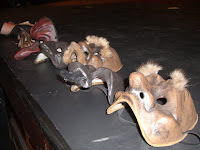
Huh-uh. We sure did get called on. "No, no," I feebly protested in my pigeon Italian, "Studenti. Studenti. No occupado (was that Spanish, Jeff?) questa volta." They weren't having it and, frankly, I was a little sick of myself as I said it, too. But, damn, was I spent. It turned out the students were working with Angelo the next day as well, so there was plenty of time for everyone, and up I went to choose a mask from the edge of the beautiful Teatro Boni stage. There they all were, and I waited for one to speak to me. I'm pretty familiar with commedia masks, but have trouble distinguishing sometimes, mainly owing to a certain amount of misinformation I've processed in the years of my informal education on the subject. For example, I had learned at some time that Pantalone had a long nose, because he was "nosey" and a phallic character. Well, he often is, but it turns out that Capitano is the one more famous for having a prominent phallus on his face, and Pantalone can have a hook or squarish nose as well. So I stood there, throwing out my presumptive conclusions, and just picked a mask which appealed. It was yellow-brown-er than the rest, with no hair accents, but lots of wrinkles and a hook nose. The point of the exercise was to improvise the mask's nature based on how it looked and felt, but I felt obliged to announce I didn't know who I had gotten as I left the stage to make my entrance. Turns out I had gone right ahead and picked up Pulcinella.

Pulcinella holds a certain fascination for me, not the least of which is owing to a desire Heather and I have to someday create our own show based on the Punch & Judy puppet theatre of Victorian England ("Punch" was inspired by commedia troupes' various "Pulcinelli"). He's also a tricky one, as his overall shape seemed to evolve from a couple of different regions of Italy, and thereby his personality can be a bit more mercurial than some. Plus he rarely gets mentioned in what I've read and heard about the standard characters; he's well-known enough, but somewhat amorphous. Typically--from what I understand--he's a trickster, with a hunch back and a prominent belly. At that moment, however, I tried to wipe all that from my mind and briefly regard the mask offstage (as Friend Patrick taught me to do) for clues about who he would make me before breathing in and putting him on.

Let me just interrupt myself to say that, though it read as a certain groggy fear at the time, it was an absolute thrill to step out on a classical Italian stage and perform in mask for a couple of actors trained in commedia dell'arte.

My mask (for truly, I made no effort toward Pulcinella once I set foot on stage) worked pretty well for me, I think. Everyone performed through a sort of guided interview with Angelo, which was interesting in this case owing to his emphatic English and my god-awful Italian, but we did get along. I began as a rather obstinate fellow, with a supportive cushion of arrogance around him that held up his body in quirky ways -- a hip raised, hands bent outward from the wrists, bird-like neck, all very vain, yet through energy instead of ease. It was (I believe) as though I knew I was the greatest, yet also knew I had to convince everyone else of it as well. I thought of the Italians (to generalize grossly for a moment) and how they all seem to be great about putting what they've got out there and loving it, and so I did that as a guy who really didn't have anything to brag about, but didn't know it. Eventually Angelo quizzed him (me) on how to seduce a woman, and I claimed complete expertise, saying and demonstrating all it took was a rapidly thrust hip from me. He had me bring up a couple of students and work it on them, and I got to play with success, selling something as success, and undeniable failure which is promptly denied. It was great fun.

Angelo -- who is also simply an incredibly funny guy, with what seems like a kind word for everyone and an endless need to be active -- also helped us with our piece two days later. The beginning of that rehearsal, I can confidently say, was the lowest point of my mood and confidence in what we were planning to perform on Saturday. We demonstrated what we had first thing, and it suddenly felt woefully inadequate, trite, and a really, really bad idea altogether. It was Thursday, two days before we were set to perform in Il Teatro che Cammina, and it was grim. I was embarrassed, frankly, and frustrated with the circumstances of our constantly pulling things together at the last minute, never seeming to have the money or time to develop or explore, and all that was really a jagged veneer of emotion covering fear: maybe I'm just not cut out for this work. Ugh. So bad.

Keeping with the Tarantino/Rashomon theme here: The performances on Saturday were not an unqualified success. We had two showings of the ultimately half-hour clown show, the first at 9:00 pm, and the last at 11:00, all as a part of a festival that took over the town with predominantly physical spectacle such as dance, circus-theatre and street performance. (For once, we were probably the least physically eccentric act on the bill.) Our first show made me want to crawl under the stage and hide; David came up to us afterwards and said, "Well that wasn't that bad," thereby straining his otherwise stalwart reputation for honesty. The second show, however, hummed. It had sound failures on both ends, which should have been fatal for a predominantly choreographed show, but the audience was with us and we all had a tremendous amount of fun and at the end, I felt I had earned their kind applause.

What happened between the two shows was this: We intended to use our little break of less-than-an-hour to explore and see other shows and generally try to forget we had another to do. Instead, we were invited into a building next door by some very kind older gentlemen who had a great view of our stage from their windows. They wanted to make sure we knew we could use the bathroom there (which we needed) and while we were there I discovered that the fly on my costume had popped permanently. I tried to ask them for a paper clip or something, explaining my situation through gesture, and they set about raiding office supplies for me. One withdrew a binder clip. "I don't think that'll work." Then he pulled out a stapler, jokingly. "Ci, ci! Parfetto!" I cried, and he, hesitating somewhat, handed it to me. I promptly stapled my wool pants closed with the knowledge that within the first ten minutes of the show I'd tear them off anyway. They found that pretty amusing, and then one of them reached into a drawer and pulled out scissors, gesturing mischievously toward my crotch. Here we were, almost completely incapable of communicating with language, and the lazzi was flowing. From there they invited us all to sit with them, and Heather worked her Italian magic on them. A friend of theirs, Silvano, the oldest yet, visited, was introduced to us, then came from out of the back room with wine and water for everyone. We relaxed. We laughed. And, after all that, Silvano worked to rope audience in to our space for the second show, possibly single-handedly ensuring us that our little courtyard performance would be full for its closing.

The hours spent working with Angelo on our piece were similar to our time with the old men, and this commonality was also in the spirit Heather and I found in our second performance. Angelo took us through what we had in terms of structure, and broke it down into bits -- bits we had already, and bits we inspired him to add. Given a little time to overcome our initial shame and frustration, we found with him a familiar game of discovery, getting excited about our connections and ideas, and really building from one moment to the next. It was brilliant. It reminded me, suddenly and unexpectedly, and from the midst of a recent history of disappointing efforts on my part, of what I love about this work and what keeps me excited about it. With Angelo we returned to our sense of play, with the old men we rediscovered our love of people, of communication, and in the final shot at the show we finally figured out how to have fun with it, and with our audience. Hell: It even happened in a three, looking at it that way!

That performance wasn't the be-all-end-all by a long shot, but it was shot of life that I had certainly been looking for lately. Maybe our enthusiasm had something to do with knowing we were being relieved of a great stress after our final show, and maybe our ease with the audience had a lot to do with their greater numbers and better understanding of what to expect. Nevertheless, coincidence or hard work or that lovely synchronicity of the two, it was a beautiful thing. And it didn't take much longer for the sun to start shining in Umbria again.